More affordable rail for people who
never take the train.
Seatsaver sells seats that would run empty to people who can't afford the train and generates significant new revenue for rail operators. Proven on Avanti with 410,958 journeys: families, shift workers and first-time passengers, 73% of them new to rail.
Cheaper trains for families and the people who need them, new revenue for operators and the Treasury.
A win-win good news story at the moment people need one, with no cost to the Treasury.
More affordable rail
Birmingham to London for £9. On the trains that have empty capacity, no railcards or forms needed.
New revenue, no subsidy
Seats that earn nothing today. 73% of passengers wouldn't have taken the train otherwise – new revenue, new passengers.
A homegrown tech story
"Changing government procurement so that it backs British business." Andy Burnham, 29 Sept 2026. Seatsaver is what that looks like in practice: a UK start-up, already contracted, delivering for the taxpayer.
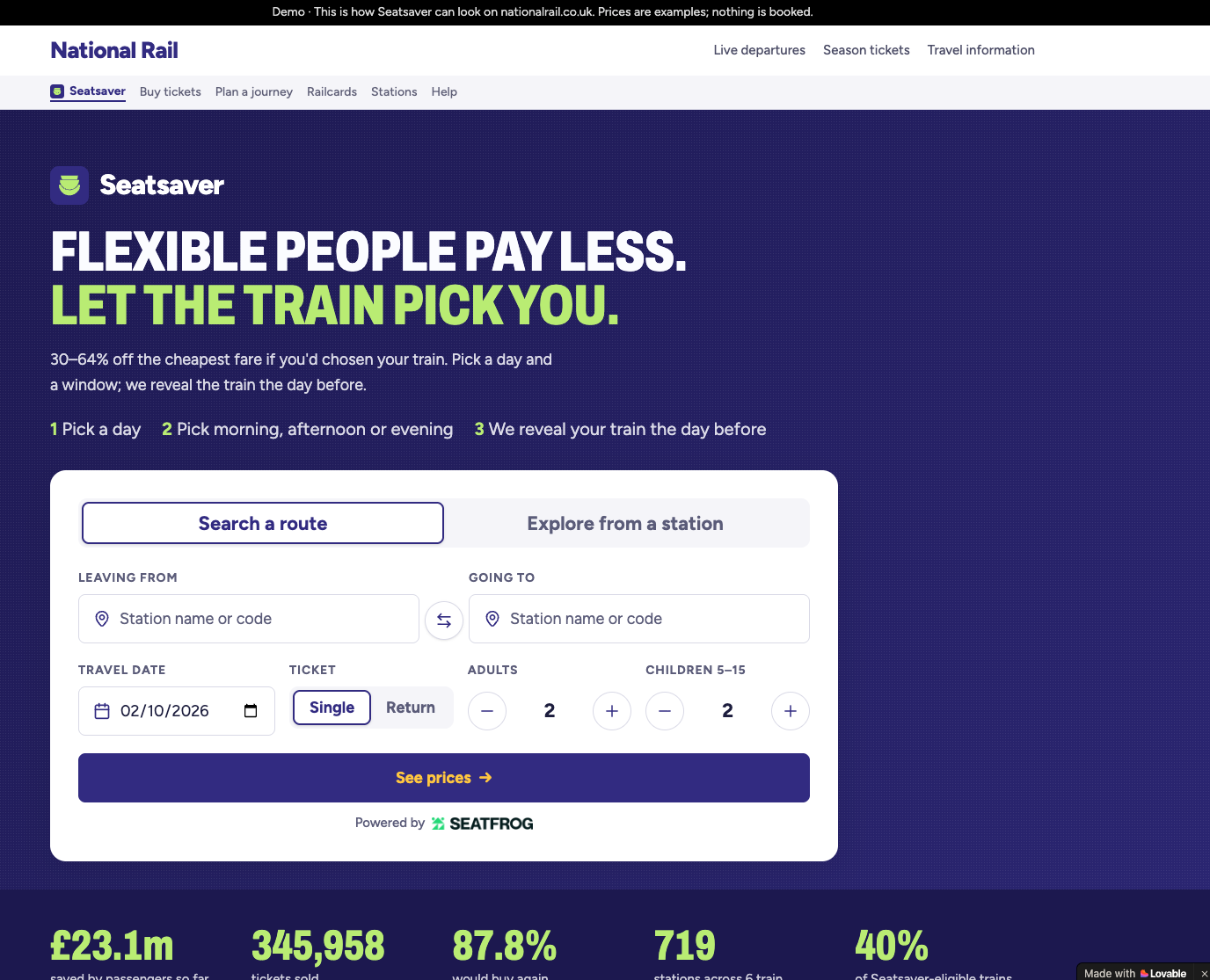
Britain has the trains, the seats and five million people pushed into poverty by the cost of travel.* Seatsaver connects them.
people pushed below the poverty line by the cost of travel.* Every one of them is a Seatsaver passenger.
Seatsaver converts 7 times the volume of the national discount scheme, from a single line.
of Seatsaver journeys are a customer's first to fourth booking. It keeps finding new people.
No form, no eligibility check, no card to apply for. Pick a day, pick a window, pay less. That is why it gets used, and why it outsells the JCP Discount Card, 16–17 Saver, Forces, Veterans and Family Railcards combined on the London–Manchester route.
* Social Market Foundation, Getting the Measure of Transport Poverty, November 2023: 5 million people in the UK are pushed below the poverty line by what they spend on transport. Other sources: Seatfrog Cost of Living briefing, March 2026 and DfT (JCP Discount Card uses, Jan–Feb 2026); Seatfrog sales data.
The passenger trades a little certainty for a much lower price. The railway chooses the train.
- 1Pick a date and a window
Morning, afternoon or evening. Quieter windows cost less, and the passenger sees that before choosing.
- 2Capacity AI picks the train
Every booking goes on a service the operator has said has room, inside limits the operator sets. Peak trains are untouched.
- 3Train revealed 24 hours before
Ticket and seat reservation by email the day before. Cancelled train? Rebooked or refunded in full.
- 4Why abstraction stays low
Nobody who needs the 08:15 can use Seatsaver to get it cheaper, because the product cannot promise any train. Abstraction requires substitution; there is nothing to substitute.
Seatsaver is a growth strategy, not a discount. It reaches a whole new audience for rail.
Most of a discount strategy goes to people who would have travelled anyway. Most of Seatsaver goes to people who wouldn't: nearly three in four of its customers would not have taken the train at all.
| Discounted tickets | Railcards & discount cards | Seatsaver | |
|---|---|---|---|
| Who gets it | Anyone. Whoever buys first, including passengers who would have paid full fare. | Anyone who qualifies and applies. Most cards cost £20–£30 a year; the Jobcentre Plus card is free. | Anyone willing to let the railway choose the train. |
| The trade-off | None. Be first. | A form, a card and usually a fee, and only if you qualify. | Certainty. This stops normal train users from choosing it. |
| Abstraction | HighMany buyers would have travelled anyway, at full fare. | LowEligibility limits who can use it. | LowPassengers who want a specific train self-select out. 73% would not have travelled by rail at all. |
| Where demand goes | Onto the discounted trains. | Any train, including busy ones. | Only where there is capacity, dynamically decided per booking as loads change. |
| Operator control | None once published. Fixed price, fixed train. | None. A fixed discount on any train. | Per train, dynamically priced. Seats released only where the operator wants them filled. |
| Evidence | Various trials. | Jobcentre Plus Discount Card: 398 uses in two months, nationwide. | 410,958journeys on one operator. |
As one customer told us:
I live in Liverpool and my folks are in Folkestone. I can’t tell you how hard we find it just now to go and see them.
This has unlocked that opportunity for us. It’s been extremely difficult due to the cost-of-living crisis. We just don’t have that type of money. But since being introduced to this, I’ve been able to go and see them for the first time in six months.”
Reconnecting people, families and communities who had been priced out of rail.
Not power users. First-timers, families, shift workers and people going to see their parents.
would not have taken the train otherwise. They would have driven, taken a coach, flown or stayed home.
would buy again · 91.2% say good value · 81.2% satisfied.
in full-time work · 11.9% retired · 43.2% aged 25–44. A personal-travel audience, not a business one.
Six operators are integrated and contracted: 40% of eligible trains and the majority of the busiest stations. LNER, CrossCountry and Transport for Wales can be weeks away, completing the intercity network. Any other operator can be added in weeks.
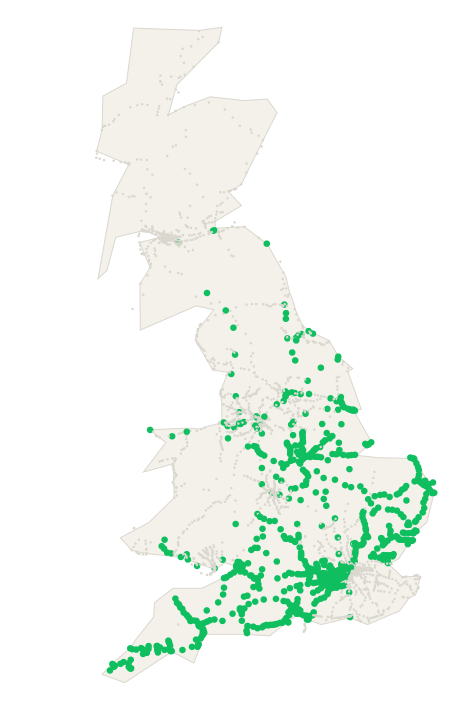
Six operators, already integrated and contracted, across their whole networks: 721 stations, 50% of passenger entries and exits, 57 of the 100 busiest, and 40.4% of the network's 4,211 Seatsaver-eligible daily services.
| Operator | Daily services | Non-commuter | Eligible | Status |
|---|---|---|---|---|
| Avanti West Coast | 290 | 80% | 232 | Live |
| Great Western Railway | 1,400 | 32% | 448 | Live |
| South Western Railway | 1,650 | 15% | 247.5 | Live |
| TransPennine Express | 320 | 78% | 249.6 | Live |
| East Midlands Railway | 450 | 58% | 261 | Live |
| Greater Anglia estimate | 1,200 | 22% | 264 | Live |
| LNER | 190 | 90% | 171 | Within 30 days |
| CrossCountry | 220 | 85% | 187 | Within 30 days |
| GTR (Thameslink, Southern, Great Northern, Gatwick Express) | 3,200 | 15% | 480 | Shorter journeys |
| Northern | 2,500 | 18% | 450 | Shorter journeys |
| Southeastern | 2,000 | 20% | 400 | Shorter journeys |
| ScotRail | 2,150 | 14% | 301 | Shorter journeys |
| London Northwestern Railway | 700 | 35% | 245 | Shorter journeys |
| Transport for Wales | 750 | 25% | 187.5 | Within 30 days |
| West Midlands Railway | 700 | 8% | 52.5 | Shorter journeys |
| Chiltern Railways | 125 | 20% | 25 | Shorter journeys |
| c2c | 322 | 3% | 9.7 | Shorter journeys |
| Network | 18,167 | 4,211 |
Source: Seatfrog station, operator and service data (29 Sept 2026); ORR entries and exits 2024–25, excluding Underground, Overground, Elizabeth line and Merseyrail. Eligible services = weekday services × non-commuter share. Greater Anglia's services are an estimate pending Seatfrog's figure. 'Full networks' = every station the six live operators run or call at (facility-owner data plus a hand list of hub calling points). CrossCountry, LNER and Transport for Wales calling points are also a hand list, pending Seatfrog route data. A new operator reaches soft launch in four weeks on existing integrations; three of the six live operators are DfTO.
At Avanti's 2026 revenue run-rate, Seatsaver is worth £70m a year to the railway.
It costs the taxpayer nothing to collect.
Avanti West Coast alone, on course for 2026. One operator, measured.
a year at the same rate across every Seatsaver-eligible service on the network. No subsidy, no capital, no fare rise.
a year if every route reached London–Manchester's penetration. The ceiling, not the forecast.
£4m: Avanti West Coast 2026 run-rate. £73m: £4m scaled by Seatsaver-eligible daily services (232 Avanti of total network). £445m: full network model applying London–Manchester penetration to all operators; the same model gives 37.3m new journeys, £1.2bn in passenger savings and 40,000–50,000 tonnes of CO2 avoided a year.
Everything is built, contracted and running. One decision puts it on National Rail within 30 days.
A note from me
Every household is under pressure, we see it in our companies and on our streets, and the railway needs revenue. Seatsaver answers both, and it isn’t a theory: 410,958 journeys already, 73% of them new to rail and £23m back in people’s pockets, all of it ready to scale now.
We’re a British tech company and proud of it. We brought some of the UK’s largest venture funds to the railway and put their capital to work alongside operators, turning empty seats into revenue and new passengers. Andy Burnham said this week he is “changing government procurement so that it backs British business”. We are that business, and we’re asking to be backed so we can deliver for the railway and for Brits around the country.
Everything is built, everything is contracted. Give us the go-ahead and we’ll rebrand it for nationalrail.co.uk and have it live in 30 days, then stand alongside DfTO, DfT and every operator until the trains with room are full of passengers who couldn’t afford them before.

One national front door, in the National Rail brand, with the operators behind it. Every UK station searchable; where it isn’t live yet, the passenger can still purchase a ticket.
CrossCountry’s board has approved. LNER and Transport for Wales, as existing customers, can switch it on. The rest of the network’s shorter journeys can follow when ready.
A family in every region paying less for the train. That's a cost-of-living story people will believe, because it's already happened on 410,958 journeys.